


June 9, 2026
Environment and Energy leader for a Sustainable Tomorrow
By Juan Pablo Osornio, Engagement and Policy Director, Earth Insight
The East African Crude Oil Pipeline Is Almost Built. The Most Damaging Work Is Happening Now.
Nearly two decades ago, commercial oil reserves were confirmed in Uganda's Albertine Graben. Since then, the East African Crude Oil Pipeline (EACOP) has been debated, delayed, and fiercely contested. Construction began in earnest in 2022. As of this spring, the pipeline stands at 80 percent complete, with commissioning targeted for July and first oil exports expected by October.
That timeline means the decisions being made right now, at specific river banks and wetland edges across Uganda and Tanzania, will shape the ecological and social health of this region for the foreseeable future. The Netherlands Commission for Environmental Assessment's independent review of the EACOP identified wetland and river crossings as the pipeline's most ecologically critical construction phase. Once they are complete, the damage to interconnected river basins, wetlands, and Ramsar sites will be effectively irreversible.
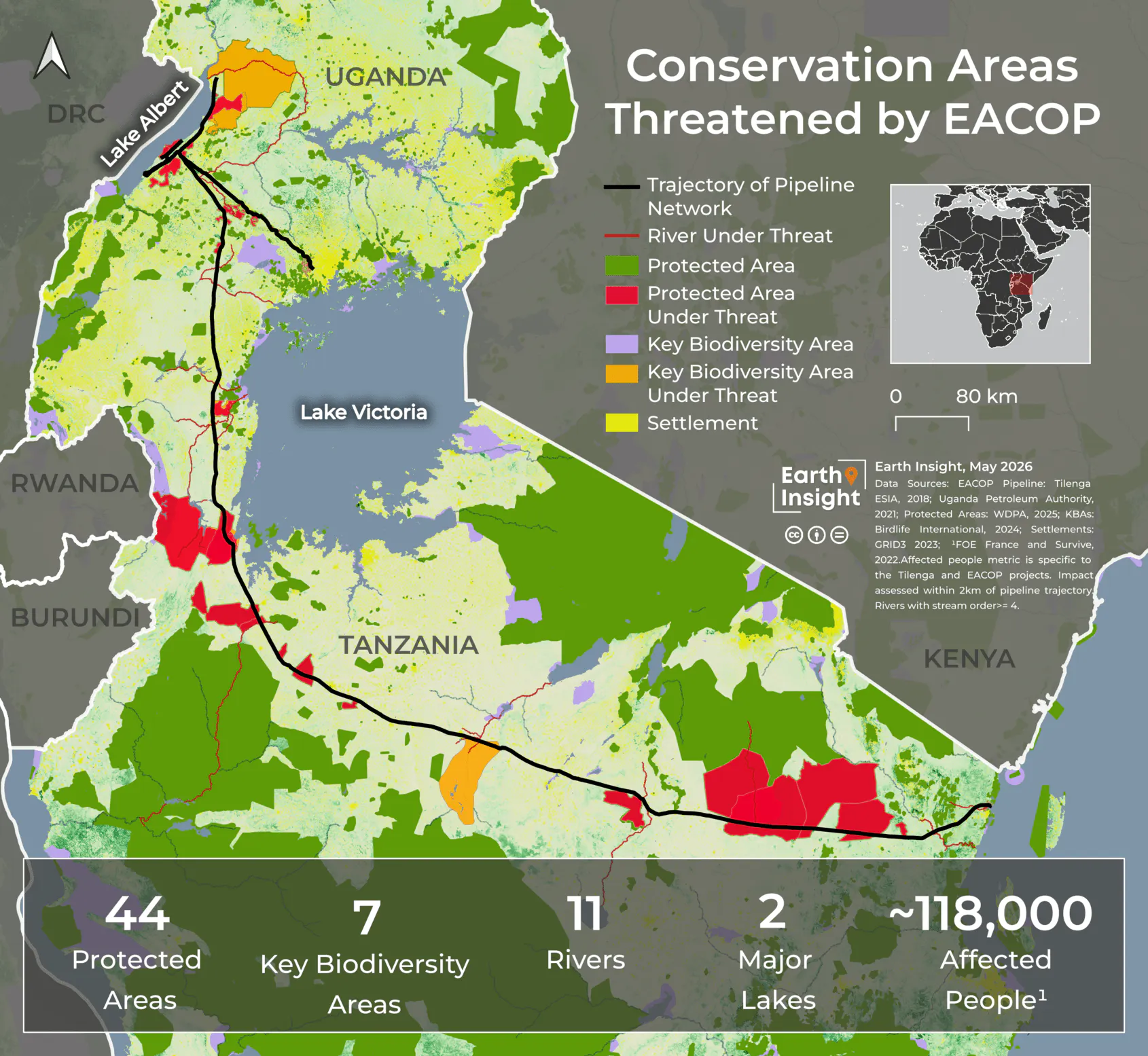
New spatial analysis shows that the EACOP and its feeder pipelines intersect with 158 wetlands in Uganda alone, overlap with 44 protected areas, and cut through seven key biodiversity areas. Eighty-four percent of the pipeline network intersects with antelope habitat, 67 percent with monkey habitat, and 22 percent with leopard habitat. This is the geography through which hot crude oil will flow under pressure for the next quarter century, having a climate impact equal to nearly 380 million tons of carbon dioxide.
Two river crossings deserve particular attention in this final construction window.
The Victoria Nile crossing sits within Murchison Falls National Park, Uganda's oldest and largest protected area and its last remaining lion stronghold. The Tilenga environmental and social impact report classified this crossing as a high adverse impact site and warned of flooding risks during all phases of the project. Plans to use horizontal directional drilling at this location pose well-documented risks to wetland systems. An independent advisory review of the EACOP found that the crossing of wetlands "remains one of the most critical activities in the construction of the pipeline." The noise from drilling and barge movements alone could mean 25 to 30 more years of wildlife disturbance in a park where elephants are already fleeing in response to the existing construction activity.
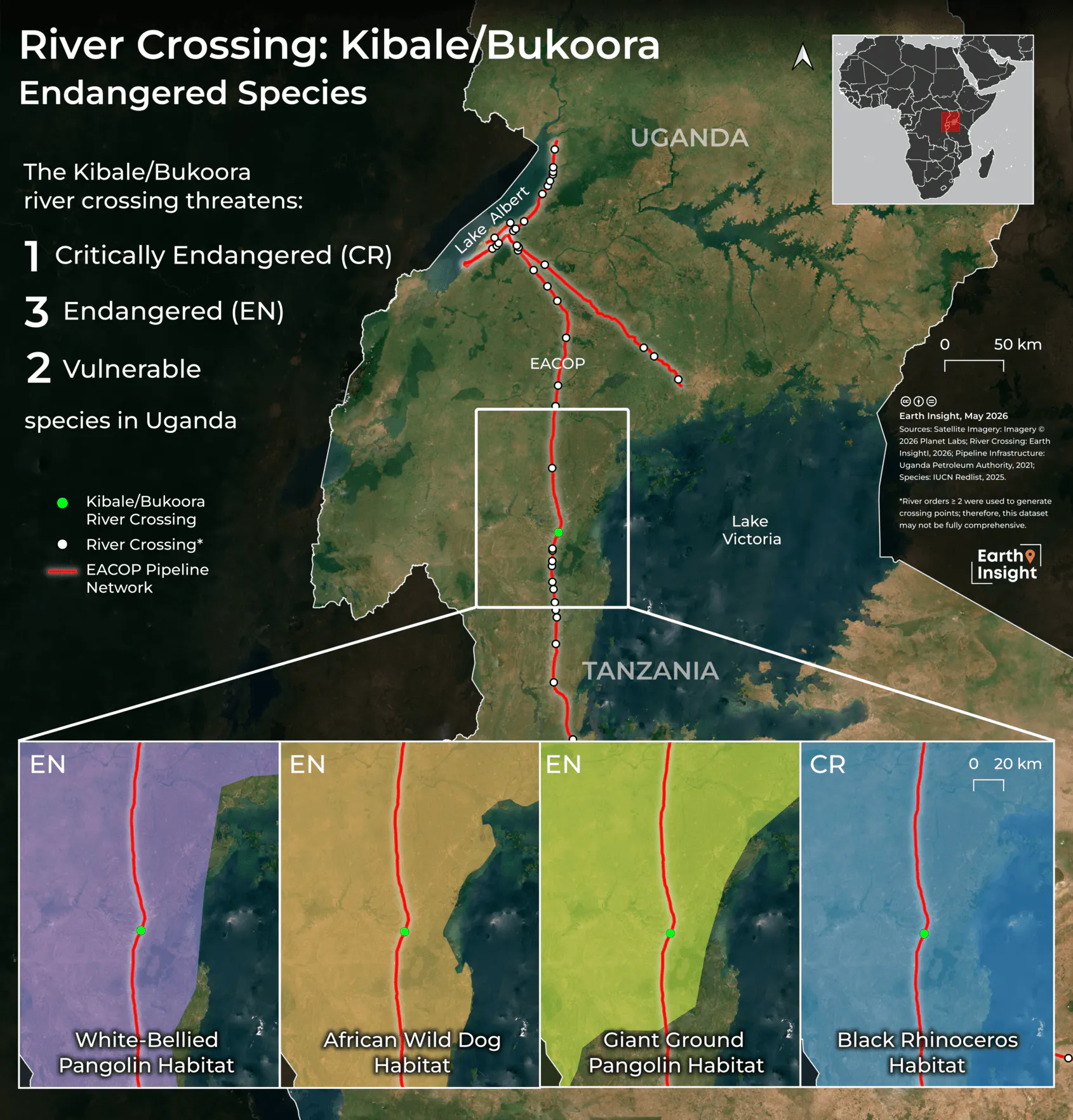
The Kibale/Bukoora river crossing in southern Uganda represents another critical point of concern. Satellite imagery from April 2026 confirms that pipeline construction has reached the riverbanks, but the river crossing itself has not yet been completed. The Kibale/Bukoora river flows into the SAMUKA Ramsar Site and ultimately into Lake Victoria, which sustains more than 40 million people across the region. Spatial analysis drawing on IUCN Red List data shows the crossing area overlaps with habitat for one critically endangered species, three endangered species, and two vulnerable species, including the white-bellied pangolin, giant ground pangolin, African wild dog, and black rhinoceros.
The financial picture offers no reassurance that these ecological risks are offset by reliable returns, making the project’s justification increasingly difficult to sustain. According to BankTrack, project costs had already climbed to $5.8 billion by December 2024, up from an original estimate of $3.5 billion — a 66 percent increase. Most major international banks and the four largest reinsurance companies in the world have withdrawn from the project. An Institute for Energy Economics and Financial Analysis report found that China's rapid electric vehicle adoption is expected to suppress global oil demand and that the value of Uganda's oil could fall 34 percent for investors and 54 percent for the country under foreseeable demand scenarios. The pipeline's heating systems, required to keep the waxy crude from solidifying at 80 degrees Celsius, have not been adequately addressed in impact assessments in terms of failure risk.